Wabi-sabi (侘び寂び) — whenever Japanese aesthetics come up, this word is never far behind. These days it often travels the world untranslated, simply as “wabi-sabi.”
And yet, if someone asked you point-blank what it means, it might be hard to answer. You wouldn’t be alone.
In a single phrase: it is the heart that finds beauty in things that are imperfect, and in things that age. And here is the surprise — both words originally meant something negative: “miserable” and “lonely.”
In this article, we’ll trace where wabi-sabi came from, and how words of hardship slowly became words of beauty — gently, for those meeting the idea for the first time.
What you’ll learn here
- Wabi and sabi were originally two separate words
- Both began with negative meanings
- Wabi was raised by the people of the tea ceremony
- Sabi was polished by the poets of waka and haiku
- The same heart flows through kintsugi and ikebana
- How to taste wabi-sabi in everyday life
Wabi and sabi were originally two different words
Though usually spoken as one — “wabi-sabi” — the two halves have separate roots.
Wabi comes from the verb wabu: to feel downcast, to feel helpless, to suffer because things won’t go your way. It described a state of the heart.
Sabi comes from the verb sabu: to grow old, to wither, to fade with time. It described what the passing years do to things.
In other words, both words originally named conditions nobody welcomed.
How “lacking” turned into “beautiful”
The turning point came in medieval Japan.
A life that would not go as one wished; quiet, lonely surroundings. Rather than lamenting these, people began to look again and ask: might there be a calm kind of richness precisely here? Beauty found in what is lacking, in what is simple — an idea sometimes called “the beauty of insufficiency.”
The way people saw aging things changed too. Tsurezuregusa (Essays in Idleness), a celebrated 14th-century collection of essays, includes a passage savoring the look of a book grown old and worn — a sign that the taste for beauty in age and wear had already taken root.
Wabi was raised by the tea ceremony
It was the world of tea that raised wabi into a full aesthetic.
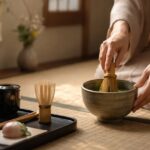
In the Muromachi period, lavish utensils imported from China — karamono — were the height of fashion in tea. The tea master Murata Jukō steered in the opposite direction, turning his eyes to the beauty within plain, unadorned utensils. This is considered the beginning of wabi-cha, “wabi tea.”
Takeno Jōō carried the spirit forward, seeing everyday vessels with fresh eyes as tea utensils; he is said to have described wabi as being honest, humble, and free of arrogance.
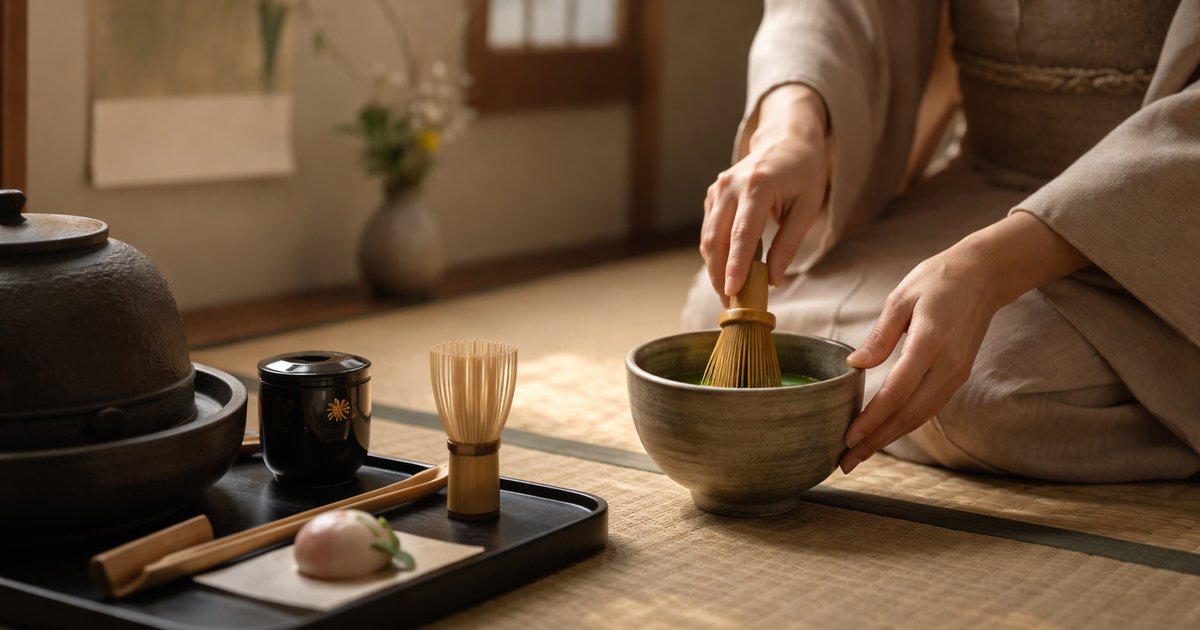
Then, in the late 16th century, Sen no Rikyū brought wabi tea to completion. Rikyū prized simple tea bowls with their irregularities and rough textures over flawlessly perfect ones. In a small, dim tea room, one faces a single bowl of tea. Wabi took shape as the richness that appears after luxury has been subtracted away.
Sabi was polished by the poets
Sabi, meanwhile, was refined in the world of poetry.
To see, in what is old, quiet, or withered, a savor that seems to seep out from within — this sensibility was passed down among medieval poets, and in the Edo period it became a central aesthetic in the haiku of Matsuo Bashō and his school.
Curiously, almost no record remains of Bashō himself directly explaining what sabi is. He never pinned it down in words; he let it drift within the poems. Which is, in itself, a very sabi way to leave things.
Raised separately, the two words came to resonate with each other and eventually merged in common speech — becoming the “wabi-sabi” we know today.
The same heart flows through kintsugi and ikebana
The heart of wabi-sabi reaches well beyond the tea room.
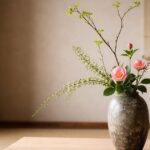
Kintsugi mends broken pottery with gold and cherishes the vessel, scars and all. Ikebana never crowds its flowers, leaves space deliberately empty, and will even use a withered branch. Through both runs the same gaze: what matters is not that a thing is perfect, but the time it has lived through.
Newest is best, shiniest is best — wabi-sabi quietly turns that assumption inside out.
Wabi-sabi in everyday life
Wabi-sabi is not distant book-learning.
A leather bag darkened by years of use. A wooden cutting board worn round at the corners. A favorite mug you keep using, chip and all. Before “it’s old, time to replace it,” pause and look at the change for a moment — and you are already standing at wabi-sabi’s door.
It doesn’t have to be perfect. It doesn’t have to be complete. If moments of feeling that way multiply a little in your daily life, that may be wabi-sabi’s gentlest gift.
In closing
Wabi-sabi began as words for “miserable” and “lonely,” and over hundreds of years arrived at “beautiful.”
Instead of grieving over what is missing, look closely at the face of what is here now. That slightly worn something in your hands today — perhaps it is already beautiful.