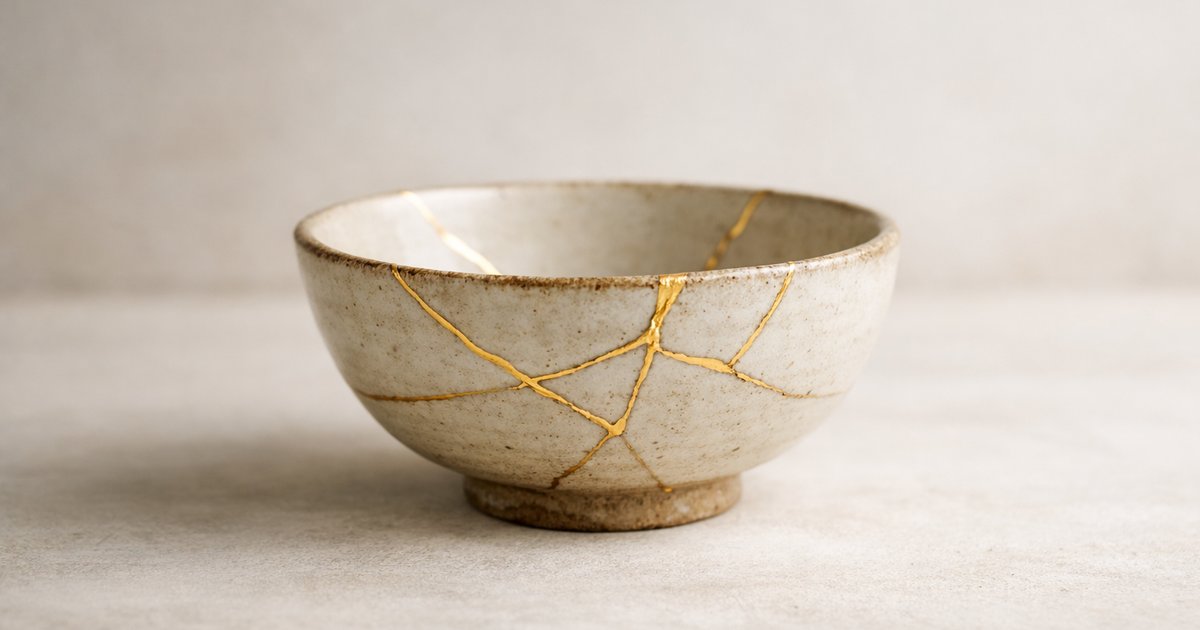
Look at a photograph of kintsugi — the Japanese art of mending broken pottery and tracing the seams in gold — and what you see is the gold.
But the gold is not what holds the bowl together. Urushi does. Japanese lacquer. The gold is powder dusted on at the very end, closer to make-up than to glue. What actually carries the weight is the dark brown tree sap underneath it.
And that sap behaves strangely. To dry, it needs damp air.
Set a freshly lacquered bowl outside on a clear, breezy day and nothing happens. Shut it in somewhere humid and it hardens. That heavy, clinging humidity of a Japanese summer — the kind everyone complains about — is exactly what urushi wants.
This is a gentle introduction to the material that sits underneath kintsugi and underneath every lacquer bowl in Japan.
What this article covers
- What urushi is — sap from a single kind of tree
- Why it will not harden in dry air
- Why one milk-bottle’s worth of sap takes twenty years
- How a tree that gives you a rash becomes a bowl you eat from
- That people here have been using it for nine thousand years
- What is really happening beneath the gold of kintsugi
- How little Japanese-grown urushi is left
- One small thing to try today
What urushi is
Urushi is the sap of a tree. That is all it is.
The tree is Toxicodendron vernicifluum, a deciduous hardwood in the sumac family. Cut into its trunk and a milky liquid seeps out. Collected, that liquid is urushi.
Fresh from the tree it is called ki-urushi, raw lacquer. From there it is refined — water content adjusted, iron added to turn it black — into the many lacquers a craftsperson keeps on the bench.
For the tree, this fluid is a wound dressing. Everything humans do with urushi — as a coating, as an adhesive — is borrowed from a tree trying to seal a cut in its own bark.
Drying, backwards
Most coatings dry as their water evaporates. Paint, ink, varnish: you want air moving over them.
Urushi does the opposite. If the moisture leaves, it stops.
The reason is that urushi does not dry — it hardens. Inside the sap is an enzyme called laccase, and it links the sap’s main compound, urushiol, molecule to molecule into a solid. To work, the enzyme needs oxygen, and it needs water to carry that oxygen to it.
So urushi stalls in dry rooms and progresses in damp ones. Heat is no help either: laccase is a protein, and too warm a room will spoil it and stop the reaction.
Craftspeople generally aim for something around 20–30°C and 70–80% humidity (the exact figures vary from source to source). Rainy season and midsummer land on those numbers by themselves — which is why you will hear that lacquer hardens best in the rain.
To hold that dampness, a lacquer workshop keeps a wooden cabinet called a muro, or an urushi-buro — a “lacquer bath.” Its interior is deliberately wetted, and freshly coated pieces go inside. They are shut away not to dry them, but to keep them damp.
The surface sets enough to touch within half a day or so. But the reaction underneath does not stop there: full hardening is said to take years. A lacquer bowl you bought last month is still, quietly, in the middle of setting.
Twenty years for one milk bottle
It is late August as this is written — and this is precisely the season when urushi is harvested.
Tapping the trees is called urushi-kaki. According to Japan’s Ministry of Agriculture, Forestry and Fisheries, the season runs from mid-June, around the start of the rainy season, to about October. A single tapper looks after more than two hundred trees, walking a circuit of roughly four days, scoring each trunk a little further and collecting what has seeped out.
No tree gives much at once. You wait for it to bleed again, and take a little more on the next round. Over a whole season, one tree yields about 180–200 grams — roughly one glass milk bottle.
That tree took fifteen to twenty years to grow from seed.
And the method now standard in Japan is koroshi-gaki, “killing tap”: take everything the tree has in a single season, then fell it. Nothing is carried over to next year. According to the Agency for Cultural Affairs’ Japan Heritage portal, the technique was brought to Jōbōji in Iwate by migrant workers from Fukui Prefecture in the Meiji era.
Twenty years of growth, one milk bottle, and the tree is finished. A good deal of what lacquerware costs is explained right there.
That said, new shoots rise from the stump. This is hōga-kōshin, coppice regeneration, and from those shoots the next tree is raised — another fifteen or twenty years. An ending that is also not quite an ending. The forest, too, is built to keep going while being used.
A tree that gives you a rash, made into a bowl
Walking past an urushi tree can be enough to bring up a rash. It is an allergic reaction to urushiol, and in Japan the tree has long been known as one to keep away from.
And yet its sap becomes the bowl you put to your lips. That is the strange turn at the heart of this material.
What causes the rash is urushiol that has not yet reacted. Once the lacquer has properly hardened, the urushiol has become something else, and cured lacquerware does not cause rashes.
Brand-new pieces are the exception: leftover urushiol can still off-gas, and some people react. The usual advice is to leave a new piece somewhere airy for a while before using it. (Sensitivity varies from person to person — if you know you react badly, don’t push it.)
Something hazardous, turned safe by time. That is what urushi is.
Nine thousand years of it
The history here runs startlingly deep.
At the Kakinoshima site in Hakodate, Hokkaido, archaeologists recovered lacquered objects roughly nine thousand years old — as far as is currently known, the oldest lacquerware in the world. That is the early Jōmon period.
And a piece of wood excavated in 1984 at the Torihama shell mound in Fukui Prefecture was identified, in a 2011 study, as a branch of an urushi tree about 12,600 years old.
That finding reopened a question. The tree had been assumed to have arrived from the Asian continent in relatively late antiquity; it turns out to have been here far earlier. Whether it was native to the Japanese archipelago all along, or crossed over very early, is still genuinely unsettled.
What is not in doubt is that people on these islands have worked with this sap on a timescale approaching ten thousand years — decorating pottery, gluing tools, coating vessels. Kintsugi grew up in a place that had been handling lacquer for a very long time.
Beneath the gold
Which brings us back to where we started.
Traditional kintsugi, done with real lacquer, is roughly three stages:
- Joining — the broken faces are bonded with mugi-urushi, lacquer kneaded with wheat flour and water into a sticky paste
- Filling — chips and gaps are filled with sabi-urushi, lacquer mixed with fine stone powder, then sanded smooth
- Finishing — lacquer is brushed along the seam, and gold or silver powder is dusted on before it sets
You may have noticed: lacquer is in all three.
The gold powder is only scattered onto the last coat. Even its adhesion comes from the lacquer hardening beneath it. Kintsugi is less a technique of gold than a technique of lacquer.
And between every stage there is waiting — days in the muro, sometimes more than a week. Kintsugi takes months not because the steps are many, but because the lacquer is setting.
It cannot be hurried. That may be the truest thing about this kind of repair.
What is left of Japanese-grown urushi
One more piece, about the present.
Ministry of Agriculture figures (for fiscal 2021) put roughly 91% of the lacquer circulating in Japan as imported, with about 9% domestically grown — some 2.0 tonnes a year. The percentages move around depending on the year and the way the count is taken, but the shape of it has not changed in a long time: most lacquer used in Japan comes from abroad.
About 75% of what is grown domestically comes from Jōbōji, in Ninohe, Iwate Prefecture. Lacquer tapped there has gone into the restoration of national treasures — the Golden Hall of Chūson-ji, the Golden Pavilion of Kyoto, the Nikkō Tōshō-gū shrine.
And since fiscal 2018, the Agency for Cultural Affairs has held to a policy that conservation work on National Treasure and Important Cultural Property buildings should, as a rule, use Japanese-grown lacquer.
That is a decision about protecting heritage, and equally a decision about whether the people who plant the trees and tap them can still make a living. When a tree takes twenty years, anything not planted now will not exist in twenty years.
Mending one bowl with gold and planting an urushi tree on a hillside turn out to be conversations about the same length of time.
Touching urushi today
You don’t need to take up kintsugi to meet this material.
Start by looking for lacquerware you already own — a soup bowl, a pair of chopsticks, a stacked box. Pick it up and run a finger over the surface. Warmer than plastic, isn’t it? You can hold a bowl of hot soup because lacquer and wood are both poor conductors of heat.
Then hold it to the light. Lacquer that looked black will often go translucent red-brown at an angle. That is the colour of the sap, still in there.
Care is far simpler than people expect: soft sponge, mild detergent, then dry it. That’s it. What to avoid is the dishwasher, long soaks, and direct sunlight — lacquer dislikes ultraviolet, and prolonged sun will change its colour.
And don’t shut it away. Lacquer gains its sheen from the oils of the hands that use it. A bowl kept for best at the back of a cupboard ages worse than one used every day.
If you are travelling, the lacquer regions — Ninohe in Iwate (Jōbōji), Wajima in Ishikawa, Aizu in Fukushima — have museums and workshop visits. If someone lets you look inside a muro, take the smell of that damp air home with you.
In closing
Urushi will not set if you try to dry it. You wet it, shut it in, and wait. Only then does it begin — and then goes on quietly hardening for years.
Twenty years of tree for one milk bottle of sap. Coat over coat over coat, and there is a bowl. Break it, and lacquer joins it again, and gold goes on top.
Nothing about this material is in a hurry.
If you have a lacquer cup within reach, drink something from it today. That dark surface is still, very slowly, setting.