An evening in mid-August. A small fire burns by the front door, and inside the house there are flowers, and a branch of red lanterns hanging above them — Japan has a few days like this every summer.
They are called Obon: the days when the spirits of ancestors are said to return home from the other world, once a year. In most regions Obon falls on 13–16 August; in parts of Tokyo and elsewhere, on 13–16 July.
The flowers offered during these days have their own name — bonbana, “Obon flowers.” They are chosen differently from an ordinary bouquet, and they are placed differently too. This article traces gently what bonbana are, for anyone meeting them for the first time.
What you’ll learn here
- What bonbana are actually for
- Misohagi — the small purple flower used to sprinkle water
- Hōzuki — why a red husk becomes a lantern
- How people once went into the hills to gather their flowers
- Which flowers tend to be avoided, and why that isn’t a rule
- How “offering a flower” grew into ikebana
What are bonbana?
Bonbana are the flowers offered during Obon to welcome the ancestors home.
For those days, households set up a small platform in front of the family Buddhist altar, called a shōryōdana (spirit shelf) or, in many places, a bondana (Obon shelf). The memorial tablets are moved onto it, and offerings are arranged there — vegetables, fruit, water — with flowers among them.
As temples explain it, the offerings are set out on this shelf so that all the spirits may be welcomed and honoured. The flowers are one part of that. Less “decoration because it is pretty,” more “part of getting ready for a guest.”
How the shelf is dressed, and even what it is called, varies a great deal from place to place. Nearly every region has its own version of “this is how we did it at home.”
Misohagi — the flower for sprinkling water
The flower named most often as the classic bonbana is misohagi (purple loosestrife).
It carries many tiny reddish-purple blossoms along a slender stem, and it happens to bloom right around Obon. Its bond with the season runs so deep that the plant has collected the season’s own names: bonbana (“Obon flower”), shōryōbana (“spirit flower”), tamayagusa (“soul-house grass”). The flower ended up named after the occasion itself.
And it is not only displayed — it is used. A sprig of misohagi is laid beside a vessel of water, and the water is sprinkled with the flower. Temples describe this as shasui kuyō, an offering of sprinkled water, made to quiet the passions of the heart.
Water shows up in the plant’s name too. One account says it resembles hagi (bush clover) and was used in misogi, ritual purification with water — hence misohagi, “purification clover.” Another says it simply grows in ditches (mizo), hence mizohagi. Neither has been settled.
Either way, this is a flower that lives near water. Purify with water, then welcome. Misohagi is the flower that has carried out that task.
Hōzuki — the red lantern
The most eye-catching thing on the shelf is probably the hōzuki (Chinese lantern plant): orange-red husks still attached to their branch, hung above the offerings.
What looks like a paper bag is the calyx — the part that once wrapped the flower, now swollen around a round fruit inside. That shape and that colour are likened to a lantern, which is why the branch is hung on the spirit shelf.
During Obon, so that returning ancestors do not lose their way, a “welcoming fire” is lit on the evening of the 13th and Obon lanterns are set glowing. The hōzuki stands in for that light: temples describe it as hung in place of a votive lamp, to guide the spirits along their road.
Even the characters used to write the name carry this. Hōzuki is written 鬼灯 — “demon lantern” — and this is said to come from its being hung in place of the lantern that marks the way when ancestors return at Obon. The first character looks fearsome, but the light here is a light of welcome.
At Sensōji temple in Asakusa, Tokyo, a hōzuki market is held every year on 9–10 July. It is said to have begun in the Meiwa era, roughly 200 years ago, and it still draws great crowds — one of the scenes that mark the start of summer.
People once went into the hills to gather them
Today most people buy their flowers at a shop. Originally, though, bonbana were gathered from the hills and fields.
Before Obon, you went out and picked whatever was in bloom that season, and set it on the shelf. In some regions the act itself has a name — bonbana mukae, “going to meet the Obon flowers.” Going to fetch the flowers was, in a sense, going to fetch the ancestors.
So older bonbana had no fixed list of species. Whatever grew in that place, in that year, in that summer — that was the Obon flower.
Something of this survives in the bundles labelled “for Obon” outside shops today. Chrysanthemum, gentian, celosia, misohagi — it is no accident that the selection leans toward flowers that bloom in summer and stand up to heat.
Choosing what to offer
Some flowers are commonly said to be best avoided as offerings. The list usually runs something like this:
- Thorned flowers (roses, thistles)
- Poisonous flowers
- Flowers with an overpowering scent
- Flowers that shed heavily and are troublesome to keep
These are customs handed down rather than rules. Practice differs by region, by household, by Buddhist school — and “it was the flower they loved” often outranks every other consideration.
If you are unsure, the simplest thing is to tell a florist that it is an offering for Obon. Nobody knows the local way better than the shop on the corner.
From offering a flower to ikebana
Here the story opens out a little.
The custom of offering flowers is said to have spread in Japan after Buddhism arrived in the 6th century — flowers set before the Buddha, butsuzen kuge. Between the Kamakura and Nanboku-chō periods, a standard form took hold: the mitsugusoku, a set of three — flower vase, incense burner, candlestick.
And this practice of offering flowers is regarded as the distant source of ikebana. Placing flowers for the sake of prayer grew, over centuries, into a culture that savours the form of the flowers themselves.
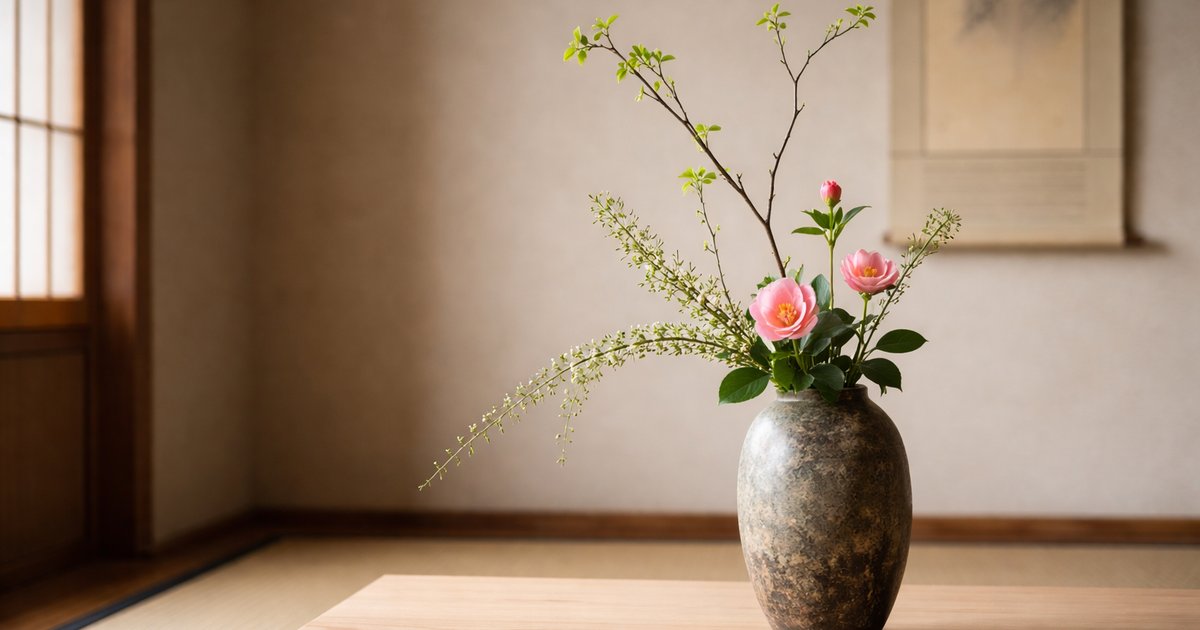
Seen that way, the single stem offered at Obon and the single stem arranged in a tokonoma alcove are distant relatives. Both branch off the same simple act: deciding to put a flower here.
In closing
Bonbana are not flowers meant to be admired. They are flowers prepared inside a house for the few days when someone is coming home.
Misohagi for sprinkling the water. Hōzuki for lighting the road. Each of them has a job to do.
If you happen to walk through Japan in mid-August, glance into a flower shop. If you see branches of red hōzuki bundled by the door, it is a sign that the houses of this country are, right now, welcoming someone.
And on the way home, you might buy a single stem yourself. It doesn’t have to be an offering. Deciding where a flower goes — that small act has been repeated on this land for more than a thousand years.
Sources
- Wikipedia (Japanese), “ミソハギ” https://ja.wikipedia.org/wiki/ミソハギ
- Wikipedia (Japanese), “ホオズキ” https://ja.wikipedia.org/wiki/ホオズキ
- Honkakuji Temple (Nichiren school, Matsudo), “お盆の由来と精霊棚” https://honkakuji.net/お盆の由来と精霊棚-2/
- Ikenobō, “いけばなの源流” https://www.ikenobo.jp/ikebanaikenobo/history/asuka/
- Hasegawa, “お盆におすすめの花は?タブーな花の種類から飾り方まで解説” https://www.hasegawa.jp/blogs/kuyou/obon-flower